

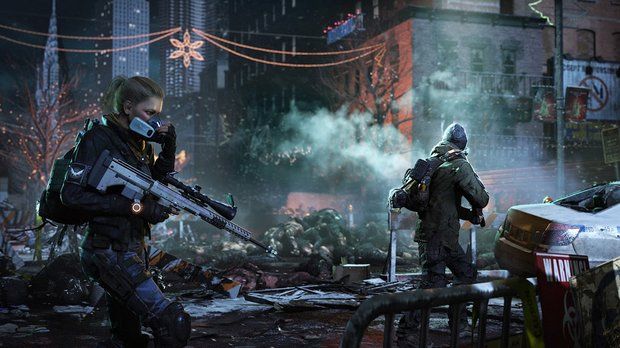
The Division is a cold, cold game. Yes, it's literally set in a version
of New York gripped by winter snow flurries, and the remnants of a
killer virus - as themes go, that's chilling enough. However, I'm also
talking about the calculating and rather stat-led way the game conducts
its business. There's no real warmth to any of The Division's systems or
stories, and this is one of the few shortcomings of an otherwise
excellent online shooter.
In terms of plot, things are kept simple enough. There's a virus
spread by infected dollar bills, and you join the action as a secret
Division agent, activated to keep some semblance of law and order in a
city that has been ravaged by death and crime. You're actually part of
the 'second wave' of Division agents, after the first one failed... for
reasons that become clear as you shoot through the game's 40-50 hours of
story/side-missions. Whereas many other Clancy games contextualise
their uber-military narratives and throw in a little conspiratorial
intrigue into the mix, there really isn't much of that spice in The
Division. As such, there's little sense of progress outside levelling up
and grinding for more gear.
More than that, though, is a sense
that The Division's world isn't one you want to exist in for large
swathes of time. One of the key aims of any persistent game is creating
an environment that players will enjoy, explore, or at least tolerate
for months and even years of their gaming life. Because if you don't
like actually being inside that virtual world, even the lure of slightly
better loot probably won't keep you logging in. The Division's New York
is a grim (if graphically accomplished) place to exist and, while the
minor details make certain areas feel a little different, most of it
looks roughly the same. One street with abandoned cars and piled up
refuse looks pretty much the same as another. As such, I don’t feel the
same desire to explore or return to specific areas as I do with other
open-world games and MMO shooters. In short, The Division's world is a
bit too depressing.

However - like the actual shooting and RPG systems themselves - it's
technically excellent. Level design is top-notch, and action areas feel
expertly crafted to perfectly suit the game's solid cover mechanics.
That's a fancy way of saying that the places where you shoot all the
dudes are really neatly put together. You'll often find that cover is
thoughtfully placed to allow you the chance to make a risky run for a
better angle on a group of bad guys. More than that, mission areas are
perfectly suited to smart team tactics - you can plan ambushes and react
on the fly to enemy movements, all while maintaining those
all-important lines of sight on your foes. Most of my mission
playthroughs were with random, silent allies during my time in The
Division and everyone instinctively knew how to make the most of cover,
how to coordinate strikes on enemies, and how to spread attacks during
boss fights. The world design is that good.
Combat itself
is decent, and works perfectly in tandem with the environment. The
Division is all about creating angles - get into the right spot and you
can hose an enemy with ease, but if they dig in and you start a
straight, cover-based shoot-out things get much trickier. Navigating
between cover-points is a joy too, thanks to the easy 'see and go'
system. Weapons? Yup, they make the right noises and feel (on the whole)
pretty balanced. There are, however, a couple of downsides to the
action. Firstly, bullet-sponge enemies aren't to everyone's taste, and
The Division's enemies are VERY spongey. While I'm reasonably happy
pouring ammo into regular enemies, there's something tiresome about
endlessly plugging away at bosses and elite foes. This game is at its
best when you're constantly moving and killing, tactically
out-manoeuvring enemies to win each encounter. But boss and elite
battles feel more like a war of attrition, as you dig into cover and
slowly whittle their health to zero before they can do the same to you.
It's a real problem when the end-game is all elite, all the time.

The second real problem with The Division's combat is what I'm
calling a 'lack of magic'. And it's here where I'm going to be horribly
predictable and mention Destiny (you knew it was coming, so don't look
so shocked). Everything in this game feels both literally and
figuratively grounded. Your movements are, quite rightly, restricted to
anything real human beings can do - you crouch behind cars, lean out,
maybe vault over an obstacle or two... but that's it. In Destiny (and
games like Titanfall and Black Ops 3) you're super-powered, and able to
zip around the environment both vertically and horizontally. You can
pause in mid-air and shoot, or wall-run around foes, or double-jump as a
desperate dodge for cover. Next to these games The Division feels very
static, very vanilla.
Not only that, you can't shoot lightning out
of your hands. Yes, yes - that's a very reductionist way of saying that
The Division's perks are incredibly restrained next to the special
abilities found in other persistent shooters. And I know this game is
all about degrees of realism, but it feels an awful lot like The
Division is desperate for some violent magic, but is only able to sneak a
little in via credible means. I've got a gun, for example, that heals
me a bit when I kill enemies. That's the kind of frustration I'm talking
about, because it's essentially 'space magic', but slipped subtly into
the game under the guise of 'maybe futuristic tech maybe'. This game
can't have outlandish perks, and that's one reason it feels restrained
and a little dull next to its competitors, despite doing all the
technical stuff exceptionally well.

Speaking of which, The Division's online elements are - to continue a
theme - technically excellent, but ultimately cold. Minor bugs around
mission completion aside, this is an exceptionally well crafted online
experience. Matchmaking is simple (if poorly explained) and effective,
quickly throwing you in with other agents and providing a largely
lag-free environment to smash baddos in. Sadly, though, there's no real
sense of community or joint effort. Every team I formed broke up the
minute a mission had finished, creating a real sense of anti-climax. And
it's not like I blame my temporary allies for failing to stick around,
as there's little to bond over in your standard mission. “Hey mate -
remember that time you died and I healed you? Yeah, crazy days.”
Again,
it comes back to this lack of magic or spark. The Division doesn't want
for customisation options or actual stuff to do - you can fiddle with
your loadout for hours, or grind for slightly better gear for months -
but there's very little that makes a significant difference to how the
game actually plays. Essentially, you're keeping pace with the
increasing damage demands of the bullet-sponge enemies, and the quantity
in which they appear.
There is one element of The Division that is truly excellent, that
genuinely sets the game apart: the Dark Zone. Eschewing traditional
multiplayer for something more tactical, this game uses raw human nature
to create a PvPvE experience that's wonderfully tense and utterly
infuriating (in a good way) all at once. In the Dark Zone it's you and
uneasy allies against a collection of increasingly tough enemies that
drop better loot than most foes in the regular game. Problem is that the
gear is contaminated, so you need to call in a chopper to extract it...
making you a prime target for everybody in the area. This always
creates a unique type of stand-off between you and other players. Sure,
you need to work together to repel any attackers, but what then? Do you
help your mate extract his gear then load yours? Or do you shoot them in
the back and take it ALL? I don't care how nice you are, how solid your
friendship... you're always going to feel that urge to take it all, or
that creeping paranoia that your friend is plotting your demise. It's
such a wonderful, brilliant system, and easily The Division's smartest,
most enjoyable feature.
It's one of the few significant glimmers
of warmth, of humanity, in an otherwise cold game. There's little doubt
that The Division understands how to be a persistent MMO-shooter, but it
perhaps lacks that understanding of why players continue to log-in to
its competitors months and years after they start playing. Even the
end-game, which is technically sound, lacks the variety or substance to
entertain long-term. Perhaps the introductions of Incursions will change
everything, but given the game's limited flexibility in terms of both
functionality and themes, it seems more likely that these missions will
simply be longer, tougher versions of what's already on offer. In the
interests of fairness, I'll certainly revisit this review in a few
months when I've had the chance to test a couple of Incursions. Until
then, the cold facts are that The Division is a competent shooter, an
accomplished RPG, but an ultimately limited experience that's unlikely
to remain your gaming obsession of choice for longer than a few months.


0 commentaires:
Enregistrer un commentaire